What Is Real Options Valuation?
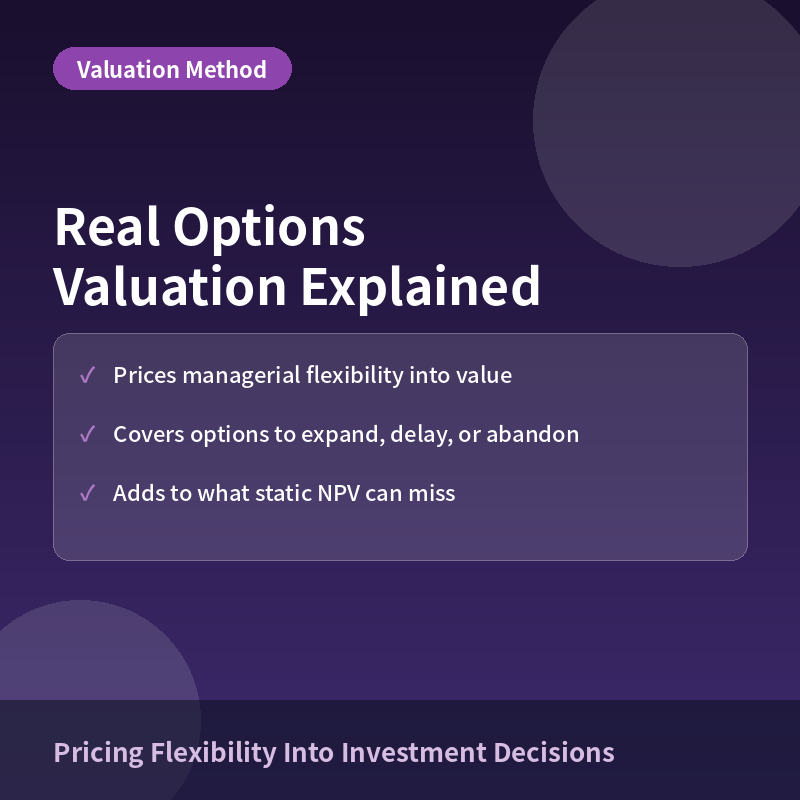
Real options valuation applies the logic of financial option pricing to real, non-financial investment decisions — capital projects, R&D programs, natural resource developments, or new product launches. The core insight is that management is rarely locked into a single, fixed course of action once an initial investment is made. Managers can adapt as uncertainty resolves: they can expand a project that is succeeding, delay an investment until conditions clarify, or abandon a project that is failing. Real options valuation attempts to put a dollar value on that flexibility, value that traditional discounted cash flow (DCF) analysis typically leaves out.
Why Static NPV Falls Short
A standard net present value (NPV) calculation typically assumes a single, fixed set of future cash flows discounted back to the present, as if the decision were made once and never revisited. In reality, most significant investments unfold in stages, with genuine decision points where management can change course based on new information — how demand actually develops, how a pilot program actually performs, how a competitor actually responds. A static NPV that ignores these decision points can systematically undervalue projects that carry meaningful uncertainty, because it implicitly assumes management would irrationally continue a losing course of action rather than adapt.
Common Types of Real Options
Option to Expand
The right, but not the obligation, to scale up an investment — for example, building a small pilot plant with the option to expand capacity later if demand turns out to be strong.
Option to Delay (Wait)
The right to postpone an investment until more information becomes available, such as waiting to develop a resource deposit until commodity prices or regulatory conditions become clearer.
Option to Abandon
The right to exit a project and limit further losses if it underperforms, rather than being contractually or operationally forced to continue investing in it.
A Worked Decision-Tree Example
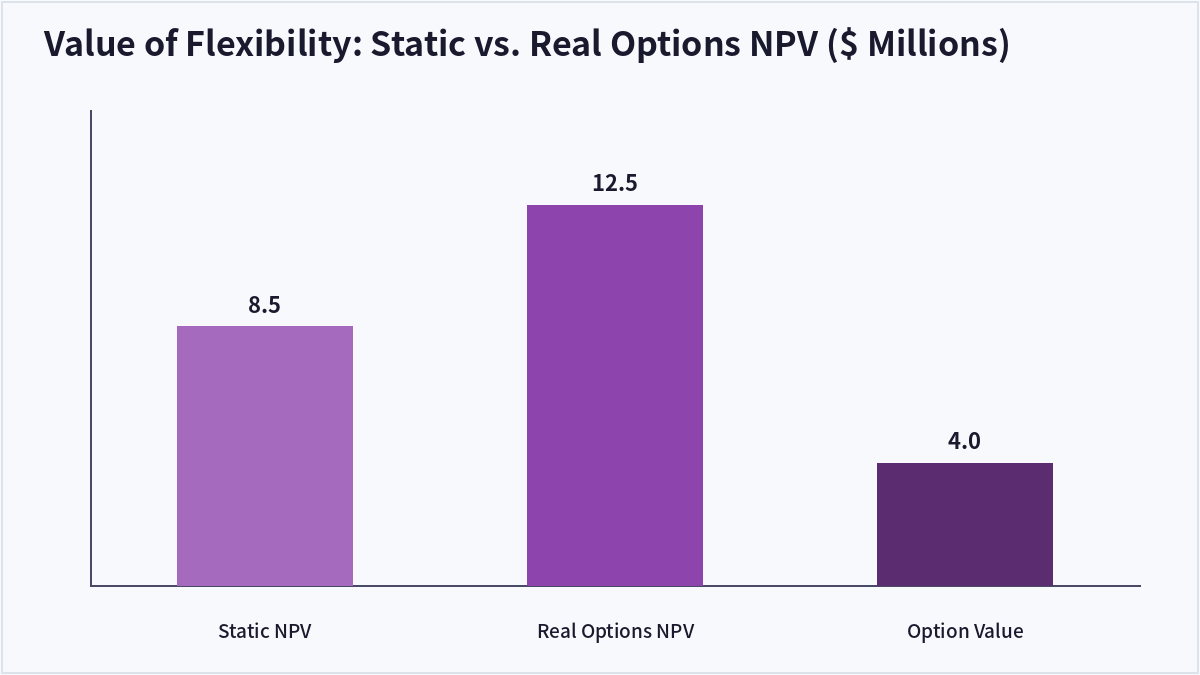
Consider a company evaluating an expansion decision one year from now, after demand uncertainty has resolved. There is a 50% probability of a high-demand scenario, in which the company invests $20 million to expand and the resulting cash flows have a present value of $45 million — an NPV of $25 million ($45M – $20M) for the expansion. There is also a 50% probability of a low-demand scenario, in which expanding would still cost $20 million but the resulting cash flows would only be worth $12 million in present value — an NPV of negative $8 million ($12M – $20M) if the company were forced to expand regardless. If the company must commit to expanding either way (no flexibility), the expected NPV is 0.5 x $25M + 0.5 x (-$8M) = $8.5 million. But because expanding is a choice, not an obligation, management would simply not expand in the low-demand scenario, avoiding that $8 million loss entirely. With that flexibility built in, the expected NPV becomes 0.5 x $25M + 0.5 x $0 = $12.5 million. The difference, $12.5M – $8.5M = $4.0 million, is the value of the real option — the value of management’s flexibility to abandon the low-demand expansion rather than being forced into it.
Real Options vs. Traditional DCF/NPV
| Aspect | Traditional NPV / DCF | Real Options Valuation |
|---|---|---|
| Treats uncertainty as | Fixed, resolved at time zero | Resolved over time, decisions adapt |
| Captures flexibility value | No | Yes |
| Modeling complexity | Lower | Higher (needs decision-tree or option-pricing inputs) |
| Best suited for | Stable, low-uncertainty projects | High-uncertainty, staged investments (R&D, resources, tech) |
Limitations of Real Options Valuation
Real options valuation is powerful but harder to apply reliably than a standard DCF. Estimating volatility for a real (non-financial) asset is difficult, since unlike a traded stock there is no continuous market price to derive it from, so analysts must rely on proxies or judgment. The models can also become complex and opaque to non-specialist stakeholders, which can make the results harder to communicate and defend. There is also a risk of overstating value if the analysis assumes management will always exercise options optimally and immediately, when in practice organizational, contractual, or behavioral frictions can delay or block an otherwise value-maximizing decision. Like any valuation model, its output is only as good as the inputs and assumptions behind it.
Frequently Asked Questions
How is real options valuation different from financial options?
Financial options give the holder the right to buy or sell a traded financial asset, like a stock, at a set price by a set date, and are priced using observable market data such as the underlying asset’s price and volatility. Real options apply the same conceptual framework — the right, not the obligation, to take an action — to real business decisions like expanding, delaying, or abandoning a project, where the “underlying asset” is the project itself and its value must typically be estimated rather than observed in a market.
What inputs does real options valuation need?
Similar categories of inputs to financial option pricing: an estimate of the underlying project’s value, the cost of exercising the option (such as an expansion investment), the time until the decision must be made, an estimate of the uncertainty (volatility) around the project’s value, and a discount or risk-free rate. In practice, many real options analyses are built as decision trees with explicit probabilities and payoffs, as in the worked example above, rather than a full continuous option-pricing model.
When is real options valuation most useful?
It adds the most value for investments with high uncertainty and genuine staged decision points — for example, natural resource projects, pharmaceutical R&D with clinical-trial go/no-go decisions, or technology ventures where management can scale up or down as market signals emerge. For simple, low-uncertainty projects with little genuine decision flexibility, a standard DCF is usually sufficient on its own.
Does real options valuation replace DCF entirely?
No. Real options valuation is typically used as a supplement to, not a replacement for, discounted cash flow analysis. A common approach is to first calculate a standard, static NPV and then separately estimate the added value of any embedded flexibility (an “option premium”) on top of it, similar to the $4.0 million example above.
Key Takeaways
Real options valuation extends traditional NPV analysis by explicitly pricing the value of managerial flexibility — the ability to expand, delay, or abandon an investment as uncertainty resolves over time. It is most useful for high-uncertainty, multi-stage investments where a static, single-path NPV calculation would understate true economic value, though it requires more complex assumptions and modeling than a standard DCF. This article is for informational purposes only and does not constitute investment advice.

QuantPro: AI Finds the Trade Before You Do
From AI-powered chart analysis to real-time market intelligence — everything a serious investor needs, in one platform.
- Automated AI chart analysis with precision trend timing
- Bull Radar: real-time visualization of geopolitical & economic shifts
- Live market-moving news and insights, curated for you
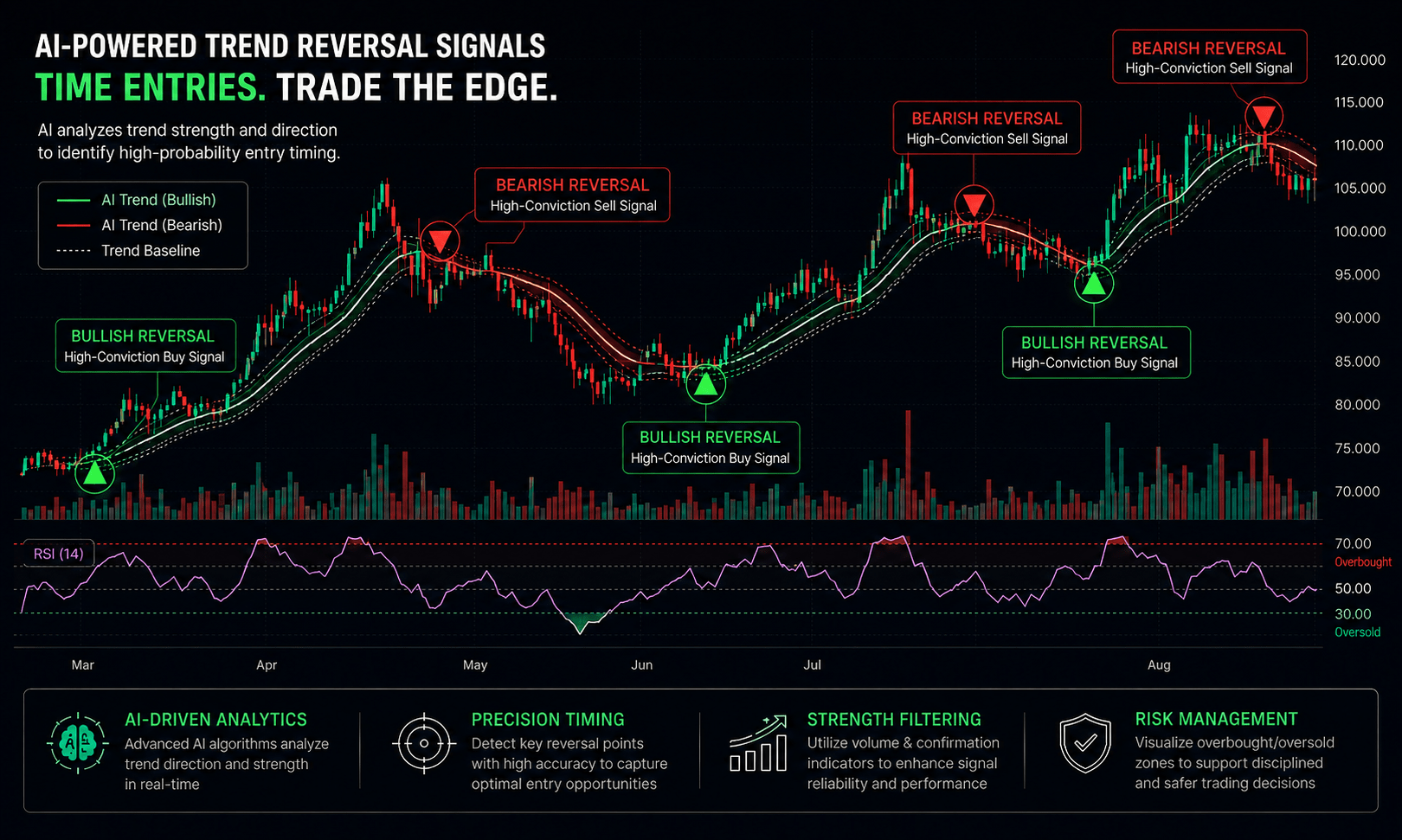
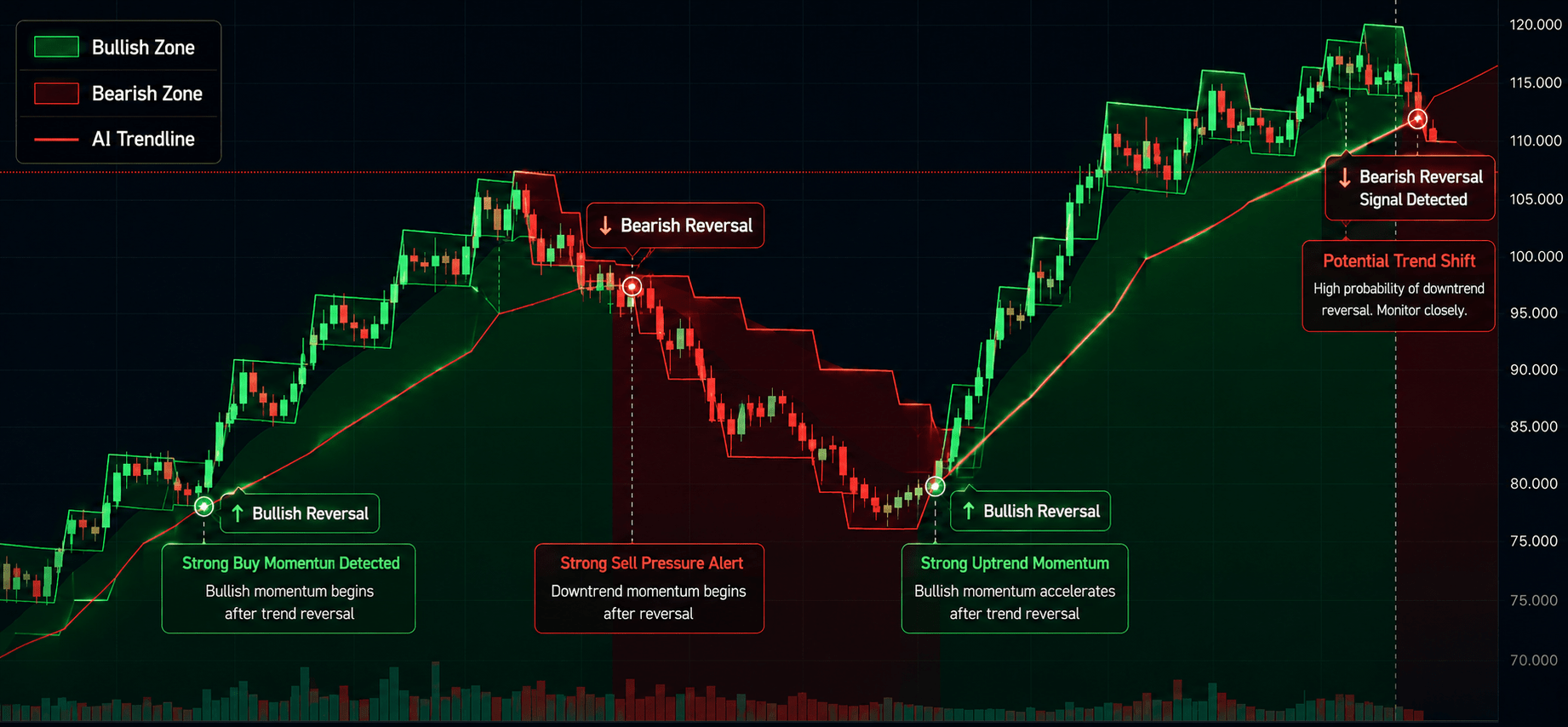
Bull Wave / Bear Wave Forecast Model
Engineered to help you read market direction and momentum faster than the crowd.
- Instantly separate bullish momentum from bearish pressure
- Pinpoint high-probability entry zones with confidence
- Chart signals clear enough for beginners, sharp enough for pros
Winning Pattern Detection
Instantly surfaces the high-probability setups that repeat across the charts — a trusted edge for timing your entries and exits.
- Spot momentum building in real time
- Catch trend-reversal points before they break
- Built for active traders who need results, not theory

AI Live Economic Dashboard
AI analyzes real-time market data — turning complex, global investment flows into clear insight in seconds.
- Track global stock markets in real time
- See exactly which assets are strong — and which are fading
- Watch how geopolitical events move the markets
About the Author