What Is the Taylor Rule?
The Taylor Rule is a formula, proposed by economist John Taylor in 1993, that suggests what a central bank’s short-term policy interest rate should be, based on how far current inflation is from its target and how far the economy’s output is from its full potential. Rather than setting interest rates by pure discretion, the Taylor Rule offers a systematic, rules-based benchmark: it prescribes a higher interest rate when inflation runs above target or the economy is overheating, and a lower interest rate when inflation runs below target or the economy is underperforming.
The Taylor Rule Formula
The Formula and Its Components
The original Taylor Rule is written as: i = r* + π + 0.5(π – π*) + 0.5(y – y*). Here, i is the suggested nominal policy interest rate; r* is the assumed neutral real interest rate (Taylor originally used 2%); π is current inflation; π* is the central bank’s inflation target (commonly 2%); and (y – y*) is the output gap, the percentage by which actual output (GDP) is running above or below the economy’s estimated potential output. The formula adds the neutral real rate to current inflation, then adds extra weight — 0.5 in the original version — for how far inflation is running above target and for how far output is running above potential.
A Worked Example
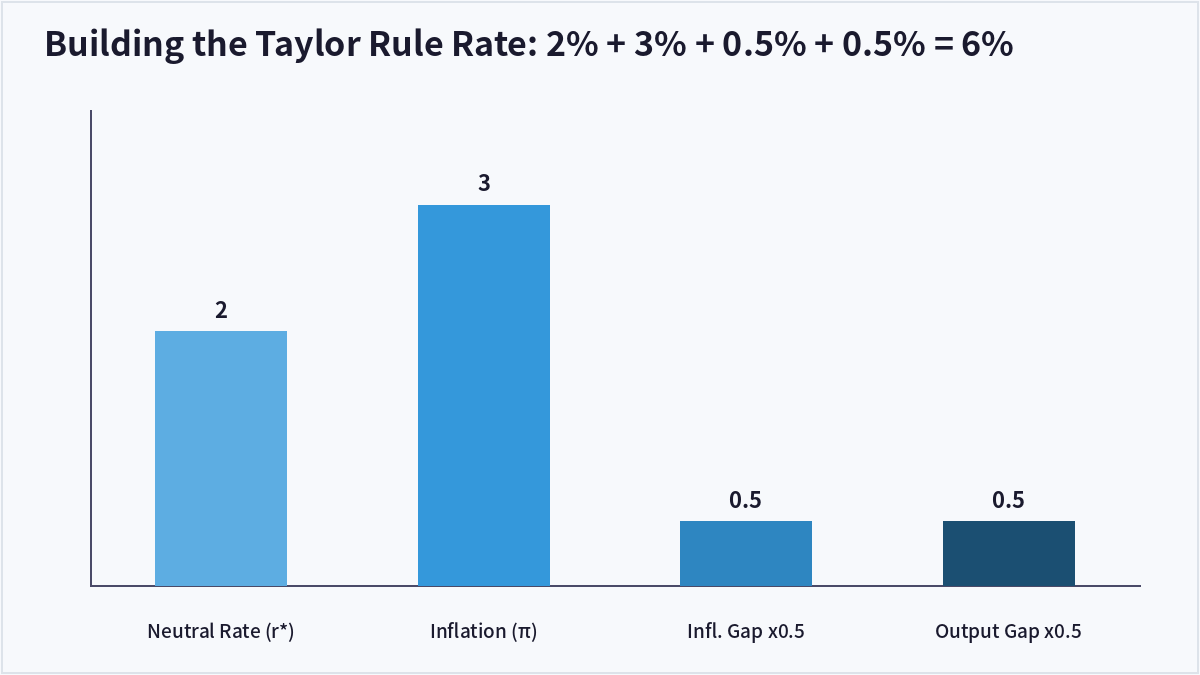
Suppose the neutral real rate (r*) is 2%, current inflation (π) is 3%, the inflation target (π*) is 2%, and the output gap (y – y*) is +1% (the economy is running 1% above potential). Plugging these into the formula: i = 2 + 3 + 0.5(3 – 2) + 0.5(1) = 2 + 3 + 0.5 + 0.5 = 6%. In this scenario, the Taylor Rule suggests a policy interest rate of 6%, reflecting both above-target inflation and an overheating economy.
How Central Banks Use (and Don’t Use) the Taylor Rule
A Benchmark, Not a Mandate
Major central banks, including the U.S. Federal Reserve, routinely reference Taylor-rule-style calculations as one input among many when assessing policy, but none follows the formula mechanically. Central banks typically operate under broader mandates — for example, a dual mandate covering both price stability and maximum employment — and weigh financial stability risks, global conditions, and forward-looking judgment that a single formula cannot fully capture. The Taylor Rule is best understood as a cross-check or reference point, not a binding instruction.
Comparing Different Taylor Rule Variants
Economists have proposed several variants of the original formula that assign different weights to the output gap or inflation gap, which can produce meaningfully different suggested rates from the same underlying data. A commonly cited “balanced-approach” variant, for instance, doubles the weight on the output gap from 0.5 to 1.0. Using the same inputs as above (r*=2%, π=3%, π*=2%, output gap=+1%), the balanced-approach version suggests i = 2 + 3 + 0.5(1) + 1.0(1) = 6.5% — half a percentage point higher than the original formula’s 6% for the identical economic data.
| Rule Variant | Output Gap Weight | Suggested Rate (Same Inputs) |
|---|---|---|
| Original Taylor Rule (1993) | 0.5 | 6.0% |
| Balanced-approach variant | 1.0 | 6.5% |
| Inertial / smoothed variants | 0.5 (dampened toward prior rate) | Gradual move toward ~6.0% |
Limitations of the Taylor Rule
The Taylor Rule’s biggest practical weakness is that two of its key inputs are themselves estimates, not observed facts. The neutral real rate, r*, cannot be directly measured and is estimated using economic models that are revised over time (this estimate is often referred to as “r-star”). The output gap likewise depends on an estimate of the economy’s potential output, which is also model-based and frequently revised well after the fact, meaning a Taylor Rule calculation done in real time can look quite different once better data becomes available. The rule also does not directly incorporate financial stability considerations, and it can imply negative interest rates during severe downturns, which most central banks cannot fully implement due to the effective lower bound on rates.
Frequently Asked Questions
Who invented the Taylor Rule?
Economist John B. Taylor introduced the rule in a 1993 academic paper, showing that a simple formula combining inflation and output gaps closely approximated the U.S. Federal Reserve’s actual interest rate decisions during the preceding years.
Does the Federal Reserve follow the Taylor Rule exactly?
No. The Federal Reserve considers Taylor-rule-style estimates as one reference point among many economic indicators and models, but its policy decisions are made through committee discretion under its dual mandate of price stability and maximum employment, not by mechanically applying any single formula.
What is “r-star” and why does it matter for the rule?
R-star (r*) is the estimated neutral, or equilibrium, real interest rate — the rate consistent with stable inflation and the economy operating at its potential when averaged over time. Because r-star cannot be observed directly and must be estimated, and because different estimation methods produce different values, it is one of the largest sources of uncertainty in any Taylor Rule calculation.
Can the Taylor Rule suggest negative interest rates?
Yes. During periods of very low inflation and a deeply negative output gap (a severe recession), the formula’s math can produce a negative suggested policy rate. Since most central banks cannot easily push conventional policy rates meaningfully below zero, they typically turn to other tools, such as large-scale asset purchases or forward guidance, when the Taylor Rule points below the effective lower bound.
Key Takeaways
The Taylor Rule offers a transparent, formula-based benchmark for what a central bank’s policy interest rate “should” be, based on how far inflation and output are running from target and potential. It remains influential as a reference point and cross-check for monetary policy decisions, but its reliance on hard-to-observe inputs like the neutral real rate and the output gap, along with its silence on financial stability risks, means real-world central banks treat it as a guide rather than an automatic rule. This article is for informational purposes only and does not constitute investment advice.

QuantPro: AI Finds the Trade Before You Do
From AI-powered chart analysis to real-time market intelligence — everything a serious investor needs, in one platform.
- Automated AI chart analysis with precision trend timing
- Bull Radar: real-time visualization of geopolitical & economic shifts
- Live market-moving news and insights, curated for you
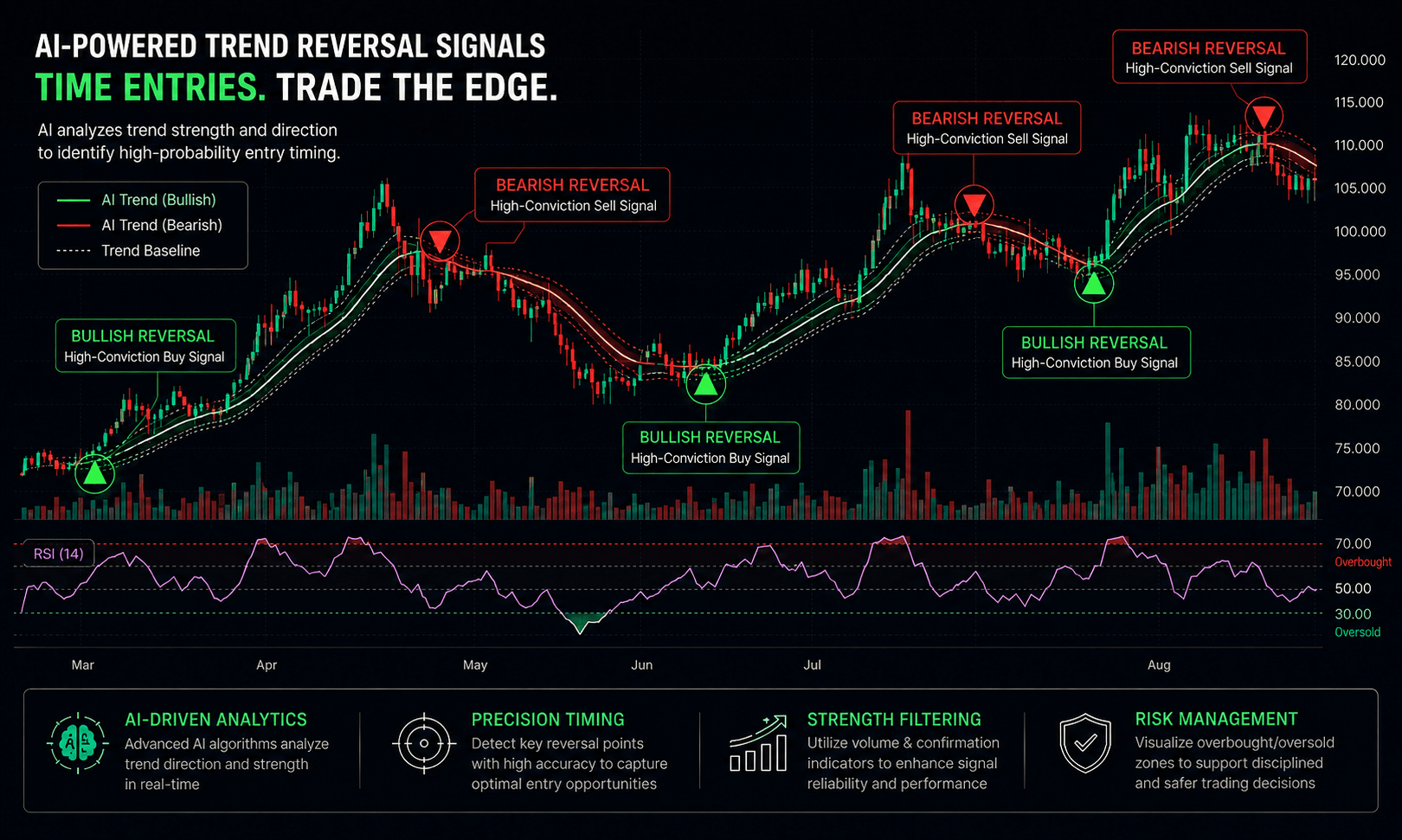
Bull Wave / Bear Wave Forecast Model
Engineered to help you read market direction and momentum faster than the crowd.
- Instantly separate bullish momentum from bearish pressure
- Pinpoint high-probability entry zones with confidence
- Chart signals clear enough for beginners, sharp enough for pros
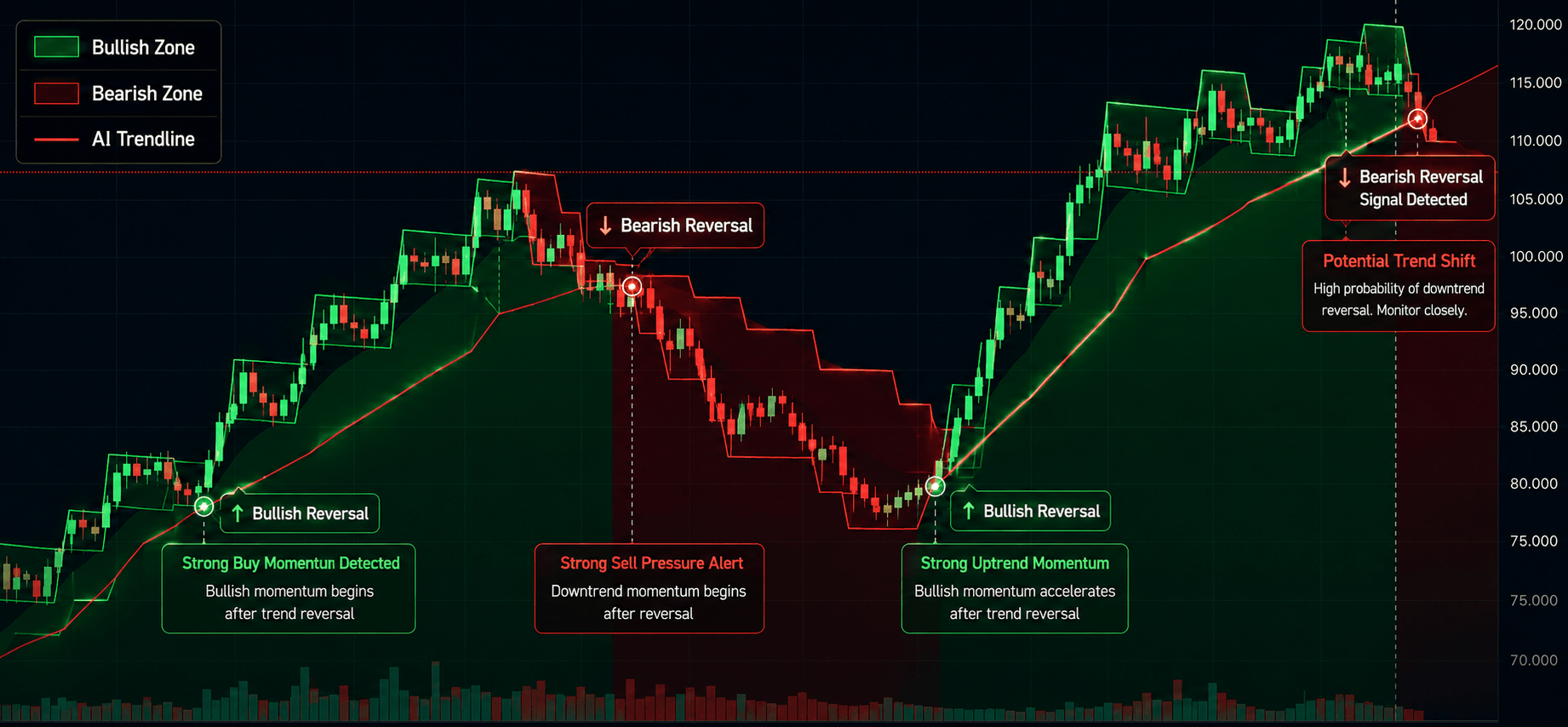
Winning Pattern Detection
Instantly surfaces the high-probability setups that repeat across the charts — a trusted edge for timing your entries and exits.
- Spot momentum building in real time
- Catch trend-reversal points before they break
- Built for active traders who need results, not theory

AI Live Economic Dashboard
AI analyzes real-time market data — turning complex, global investment flows into clear insight in seconds.
- Track global stock markets in real time
- See exactly which assets are strong — and which are fading
- Watch how geopolitical events move the markets
About the Author