Definition: A Statistical Manipulation Detector
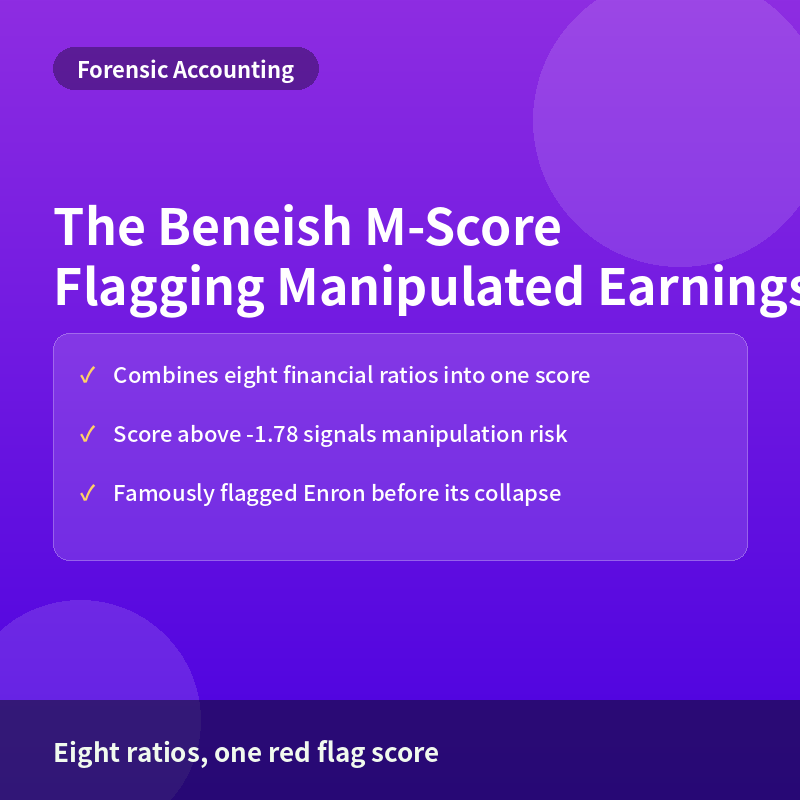
The Beneish M-Score is a statistical model developed by accounting professor Messod Beneish that combines eight financial ratios, drawn from a company’s financial statements, into a single score designed to flag a heightened probability that the company has manipulated its reported earnings.
How It Works: The Eight Variables and Threshold
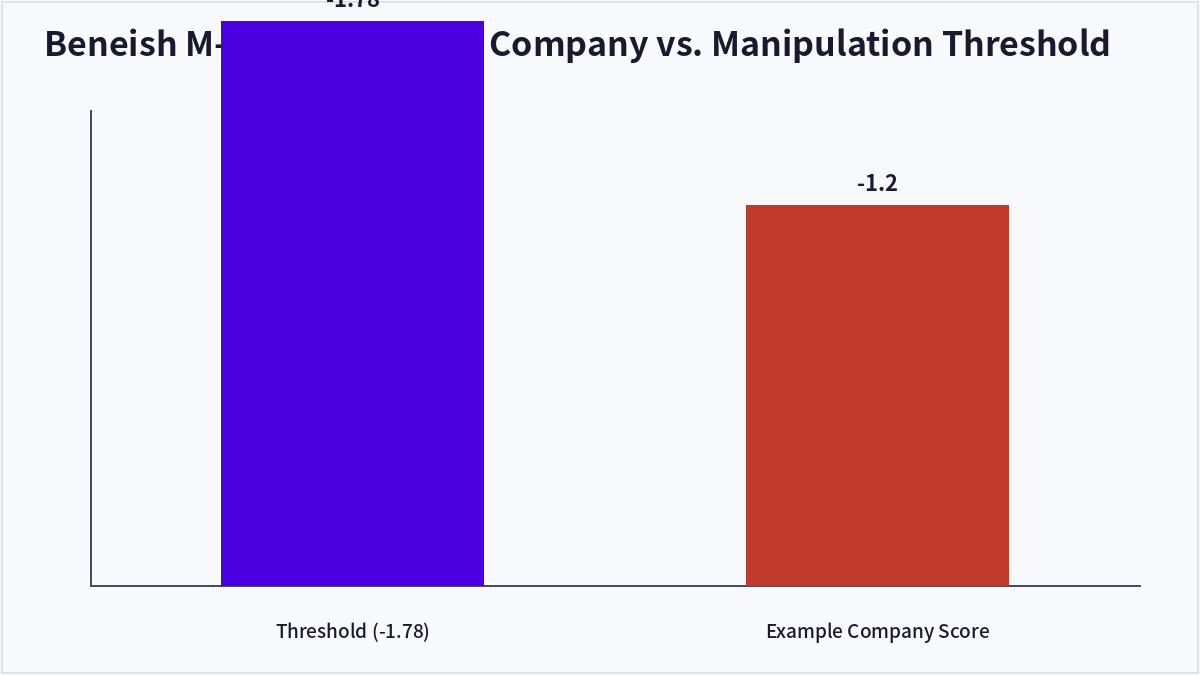
The formula weights variables such as the Days Sales Outstanding Index, Gross Margin Index, Asset Quality Index, and Sales Growth Index, among others, each capturing a way that manipulated earnings might distort financial statement trends. A resulting M-Score above approximately -1.78 is generally treated as a warning sign that a company is more likely to be manipulating earnings.
Notable Track Record
The Beneish M-Score gained significant attention for having flagged Enron as a likely earnings manipulator years before its 2001 collapse, based purely on its publicly filed financial statements, which is often cited as a key example of the model’s practical relevance.
| M-Score Result | Interpretation | Suggested Investor Response |
|---|---|---|
| Below -1.78 | Lower probability of earnings manipulation | No specific red flag from this model |
| Above -1.78 | Higher probability of earnings manipulation | Warrants closer review of financial statement quality |
Frequently Asked Questions
Does a high M-Score prove a company is committing fraud?
No, the M-Score is a probabilistic screening tool based on statistical patterns, not direct proof of fraud; a high score should prompt further investigation into financial statement quality rather than be treated as a final verdict.
Can I calculate the Beneish M-Score myself?
Yes, all eight input variables are derived from figures available in a company’s standard financial statements (balance sheet, income statement, and cash flow statement), so investors with access to those filings can compute the score independently.
How is the Beneish M-Score different from the Altman Z-Score?
The Altman Z-Score is designed to estimate a company’s probability of bankruptcy based on solvency and liquidity measures, while the Beneish M-Score is specifically designed to flag the probability of earnings manipulation, addressing a different question entirely.
Is the Beneish M-Score still relevant today?
It remains a widely referenced academic and practitioner tool for forensic financial analysis, though like any single quantitative model, it is generally used alongside other qualitative and quantitative red flags rather than in isolation.
Key Takeaways
The Beneish M-Score combines eight financial statement ratios into a single figure designed to flag a heightened statistical probability of earnings manipulation, with scores above roughly -1.78 treated as a warning sign. It is a screening tool for further investigation, not definitive proof of fraud. This article is for informational purposes only and does not constitute investment advice.

QuantPro: AI Finds the Trade Before You Do
From AI-powered chart analysis to real-time market intelligence — everything a serious investor needs, in one platform.
- Automated AI chart analysis with precision trend timing
- Bull Radar: real-time visualization of geopolitical & economic shifts
- Live market-moving news and insights, curated for you
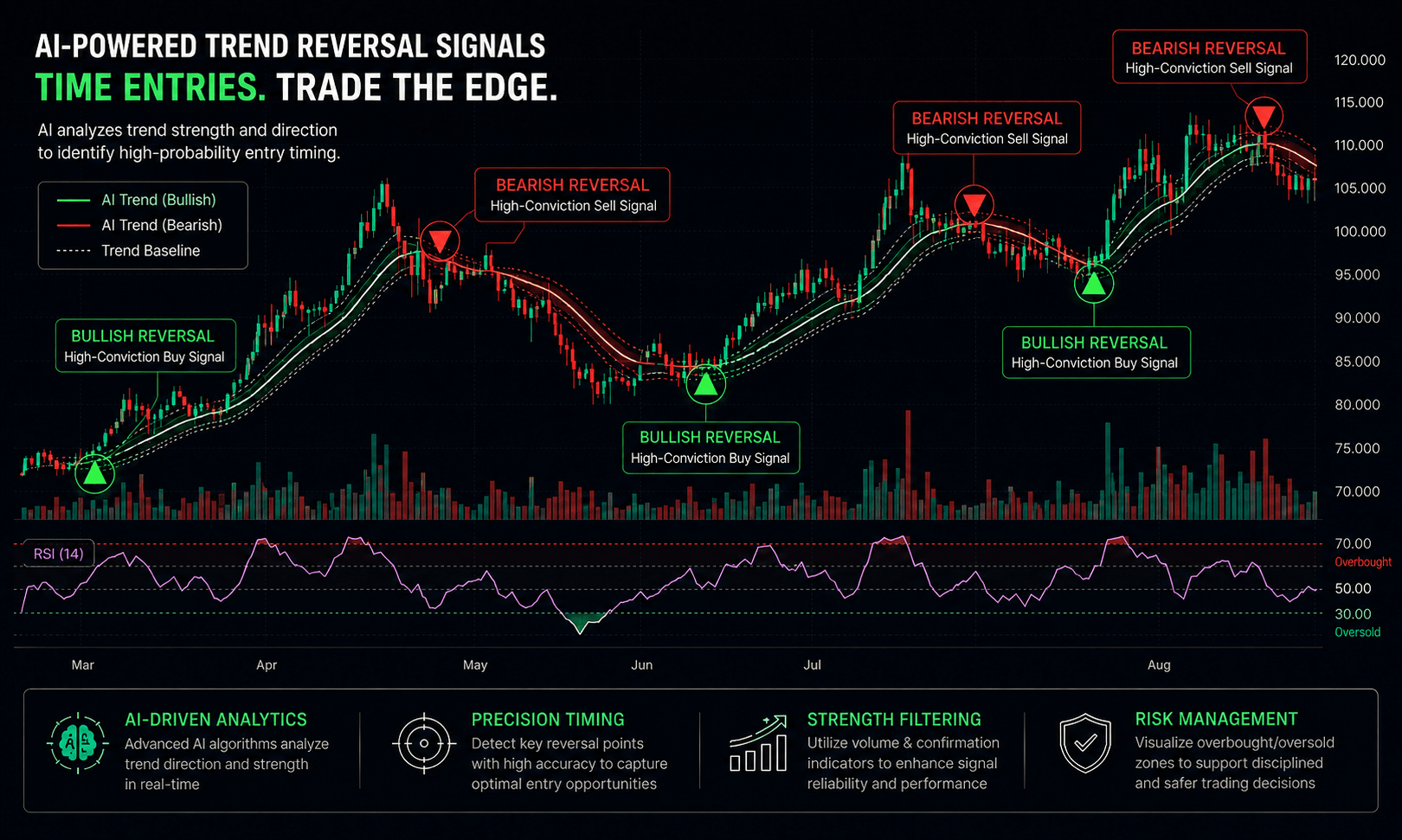
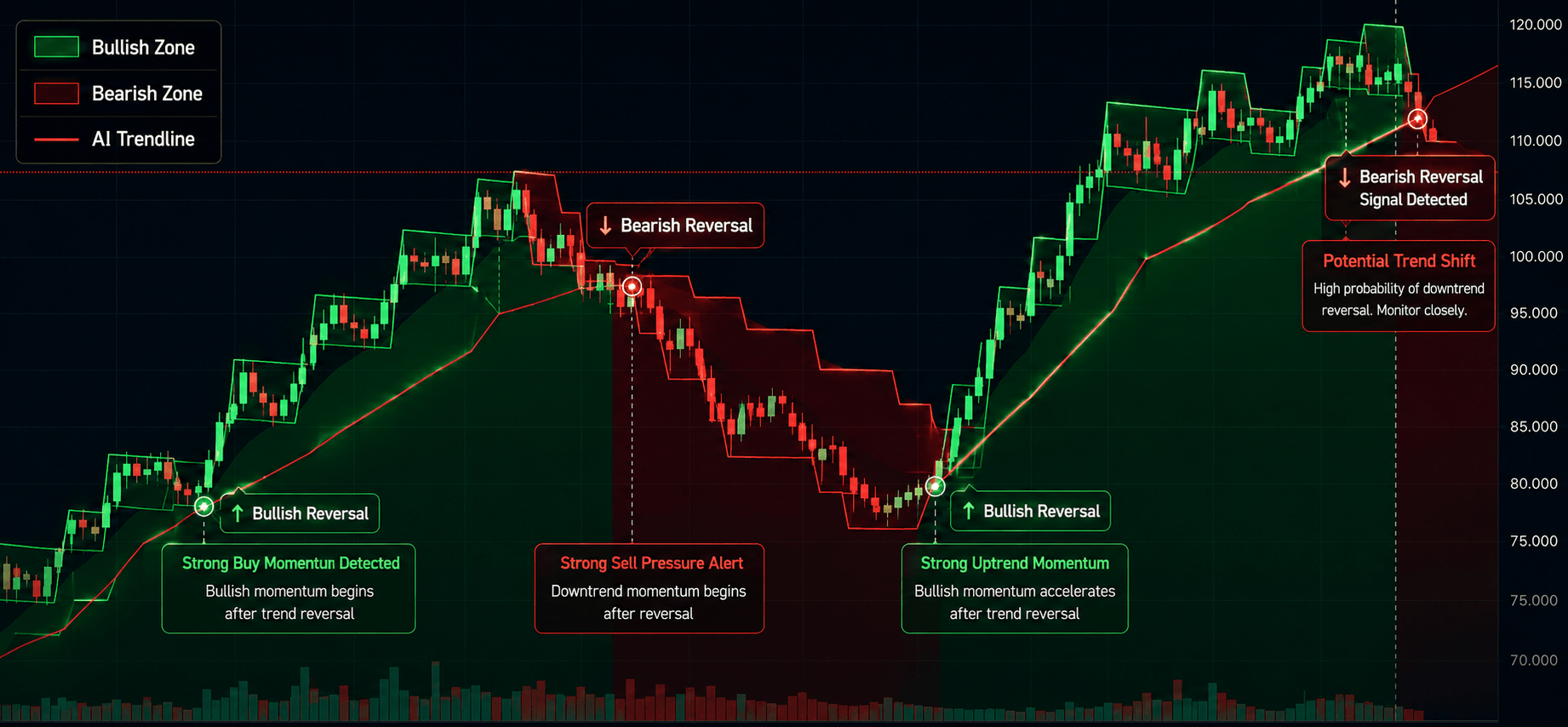
Bull Wave / Bear Wave Forecast Model
Engineered to help you read market direction and momentum faster than the crowd.
- Instantly separate bullish momentum from bearish pressure
- Pinpoint high-probability entry zones with confidence
- Chart signals clear enough for beginners, sharp enough for pros
Winning Pattern Detection
Instantly surfaces the high-probability setups that repeat across the charts — a trusted edge for timing your entries and exits.
- Spot momentum building in real time
- Catch trend-reversal points before they break
- Built for active traders who need results, not theory

AI Live Economic Dashboard
AI analyzes real-time market data — turning complex, global investment flows into clear insight in seconds.
- Track global stock markets in real time
- See exactly which assets are strong — and which are fading
- Watch how geopolitical events move the markets
About the Author