What Is Market Capitalization?
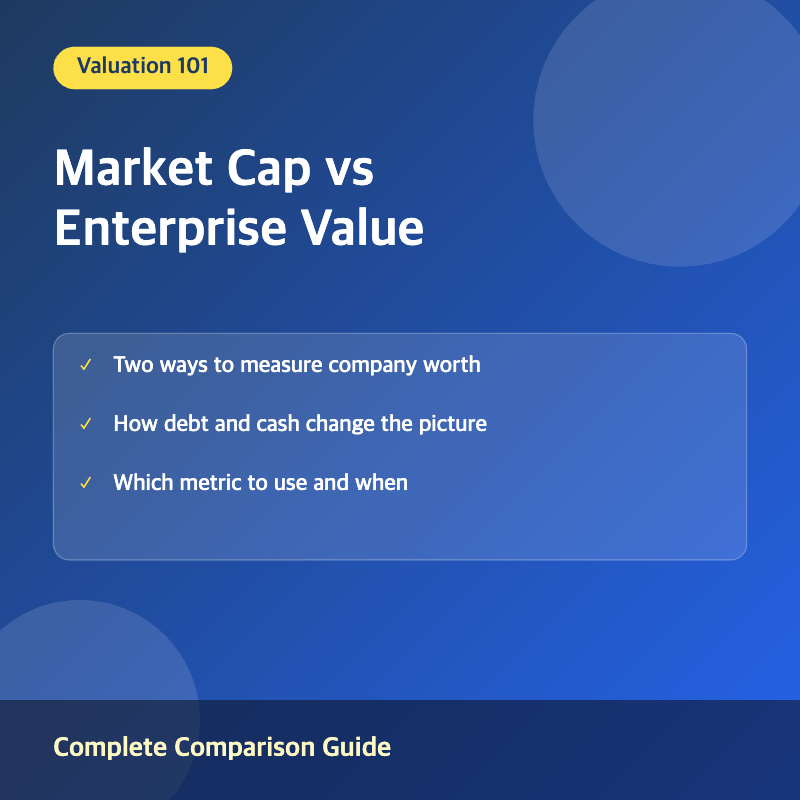
Market capitalization is the total market value of a company’s outstanding shares, calculated by multiplying the current share price by the total number of shares outstanding. It is the most commonly cited measure of a company’s size and is used to classify companies as large-cap, mid-cap, or small-cap.
How Market Cap Is Calculated
The formula is simple: Market Cap = Share Price × Shares Outstanding. For example, if a company has 500 million shares outstanding trading at $40 per share, its market capitalization is $20 billion. This figure reflects only the equity value of the company as priced by the stock market.
What Is Enterprise Value?
Enterprise value (EV) represents the total value of a company, including both its equity and its debt, minus cash and cash equivalents. EV is often described as the theoretical takeover price, since an acquirer would need to pay off debt and would receive the target’s cash reserves.
Market Cap vs Enterprise Value Comparison Table
| Metric | Market Capitalization | Enterprise Value |
|---|---|---|
| Formula | Share Price × Shares Outstanding | Market Cap + Total Debt − Cash & Equivalents |
| What it measures | Equity value only | Total company value (equity + debt − cash) |
| Accounts for debt | No | Yes |
| Accounts for cash | No | Yes |
| Best used for | Comparing company size | Comparing valuation across capital structures |
Why Enterprise Value Matters for Valuation
A Fuller Picture of Company Worth
Two companies with identical market caps can have very different enterprise values if one carries significant debt while the other holds large cash reserves. EV captures this difference, making it a more accurate metric when comparing companies with different capital structures or when evaluating a potential acquisition target.
Common Valuation Ratios That Use EV
Enterprise value is a key input in valuation multiples such as EV/EBITDA and EV/Revenue, which are widely used because they are capital-structure neutral. Unlike the price-to-earnings ratio, which relies on market cap, these EV-based ratios allow for cleaner comparisons between companies with different debt levels.
Practical Example
Calculating EV Step by Step
Suppose Company A has a market cap of $10 billion, total debt of $3 billion, and cash of $1 billion. Its enterprise value would be $10B + $3B − $1B = $12 billion. This $12 billion figure is what an acquirer would effectively need to account for when considering a full buyout, since the debt must be assumed or repaid.
When Market Cap and EV Diverge Significantly
Highly leveraged companies, such as those in capital-intensive industries like telecommunications or utilities, often show a much larger enterprise value than market cap due to substantial debt loads. Conversely, cash-rich technology companies may have an enterprise value noticeably lower than their market cap.
Frequently Asked Questions
Is a higher enterprise value always a bad sign?
Not necessarily. A higher EV relative to market cap simply indicates significant debt in the capital structure, which can be a normal part of business operations in capital-intensive industries. It becomes a concern only when debt levels are unsustainable relative to earnings.
Can enterprise value be negative?
Yes, in rare cases. If a company holds more cash than the combined value of its market cap and debt, its enterprise value can turn negative, which sometimes occurs with cash-rich, undervalued small-cap companies.
Which metric should investors focus on?
Market cap is useful for a quick sense of company size, while enterprise value is more appropriate for valuation comparisons and assessing acquisition scenarios. Most thorough analyses consider both metrics together.
Does enterprise value include preferred stock and minority interest?
A more precise enterprise value calculation also adds preferred equity and minority interest to the formula, though the basic version (market cap + debt − cash) is commonly used for simplicity in most analyses.
Key Takeaways
Market capitalization measures only the equity value of a company, while enterprise value provides a more complete picture by incorporating debt and cash. Investors comparing companies across different capital structures, or evaluating potential acquisitions, should rely on enterprise value and EV-based ratios like EV/EBITDA for a more accurate assessment. This article is for informational purposes only and does not constitute investment advice.

QuantPro: AI Finds the Trade Before You Do
From AI-powered chart analysis to real-time market intelligence — everything a serious investor needs, in one platform.
- Automated AI chart analysis with precision trend timing
- Bull Radar: real-time visualization of geopolitical & economic shifts
- Live market-moving news and insights, curated for you

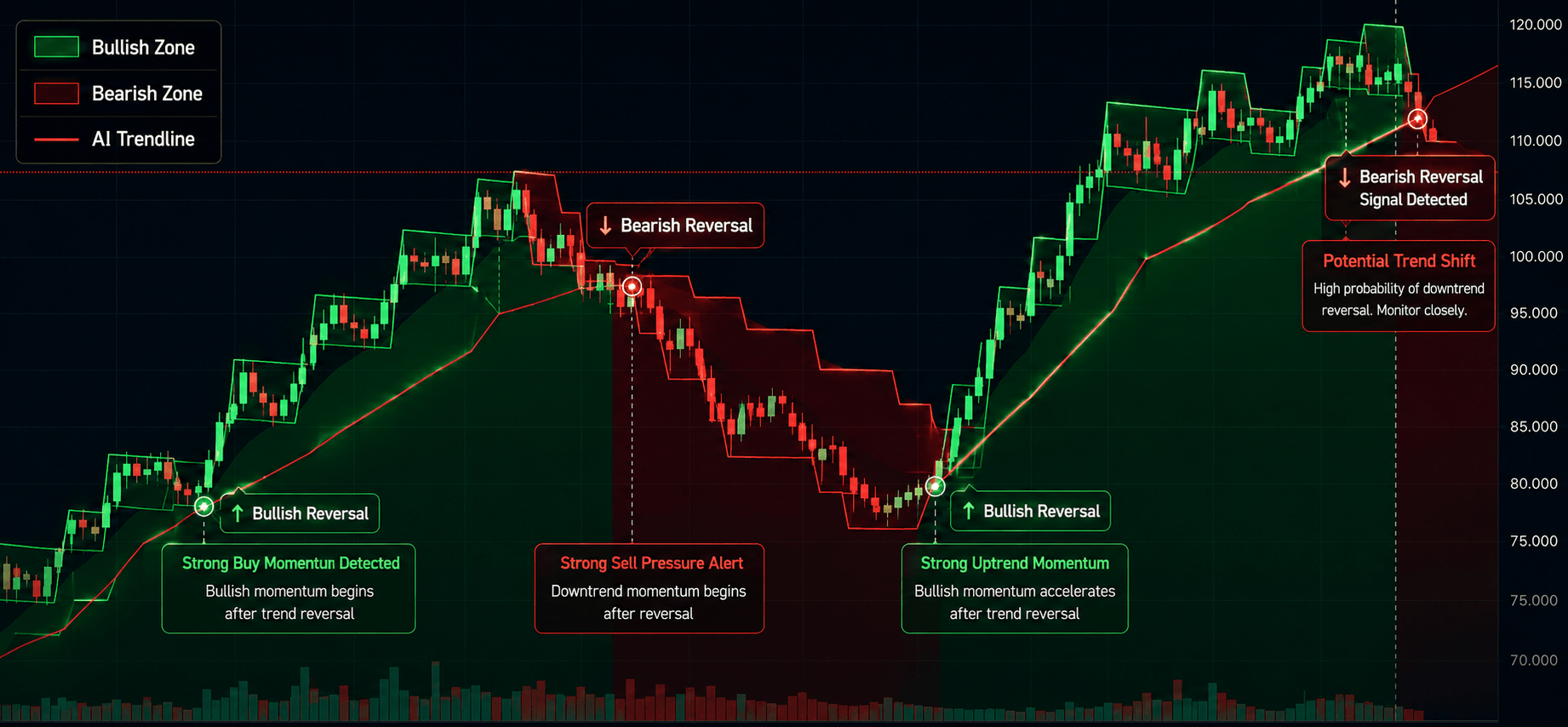
Bull Wave / Bear Wave Forecast Model
Engineered to help you read market direction and momentum faster than the crowd.
- Instantly separate bullish momentum from bearish pressure
- Pinpoint high-probability entry zones with confidence
- Chart signals clear enough for beginners, sharp enough for pros
Winning Pattern Detection
Instantly surfaces the high-probability setups that repeat across the charts — a trusted edge for timing your entries and exits.
- Spot momentum building in real time
- Catch trend-reversal points before they break
- Built for active traders who need results, not theory

AI Live Economic Dashboard
AI analyzes real-time market data — turning complex, global investment flows into clear insight in seconds.
- Track global stock markets in real time
- See exactly which assets are strong — and which are fading
- Watch how geopolitical events move the markets
About the Author